Getting It Booked In
When a spring lets go, the door usually won't move at all, or it slams down the last foot of track. That's not a job to put off - a door held up by one working spring on a double-torsion setup is carrying weight it wasn't built to carry, and the second spring tends to follow within weeks. Call and tell us the door size, whether it's one spring or two, and whether the door is stuck open or stuck shut. That tells us which spring size and wind direction to load on the truck before we head out. We work the same footprint every day - Hudson Oaks, Willow Park, White Settlement, Mineral Wells, and Oak Trail Shores - so we're not guessing at drive times or carrying the wrong spring gauge for the neighborhood. One limitation worth saying up front: if the springs are the older style with no safety cable running through the coil, we replace with the cabled version. It costs a little more than swapping like for including but a bare spring under tension in a garage over a car isn't something we'll leave as we found it.
What Causes It Around Here
Housing stock across this service area mostly went up between 1966 and 2010, with the bulk of it - across all thirteen towns we cover - built in the 1980s and 90s. That matters for springs because a torsion spring is rated in cycles, not years, and a door installed in, say, 1988 has had three-plus decades to rack up open-and-close counts. Most residential torsion springs are rated somewhere around 10,000 cycles. Do the math on a household that opens the garage twice a day for thirty-some years and you land right at the failure point a lot of these calls come from. The climate band here runs moderate on heat, which isn't the extreme swing you'd get somewhere with hard freezes or true desert heat, but it still means the coil metal is expanding and contracting through the day, every day, and that fatigue adds up the same way mileage does on a car. It's less about one bad storm and more about a spring that's simply logged its miles. Original hardware from that build era also tends to be the smaller wire gauge that was standard at the time, which wears faster on a door that's had a heavier insulated replacement panel put on it since.
What You Are Seeing
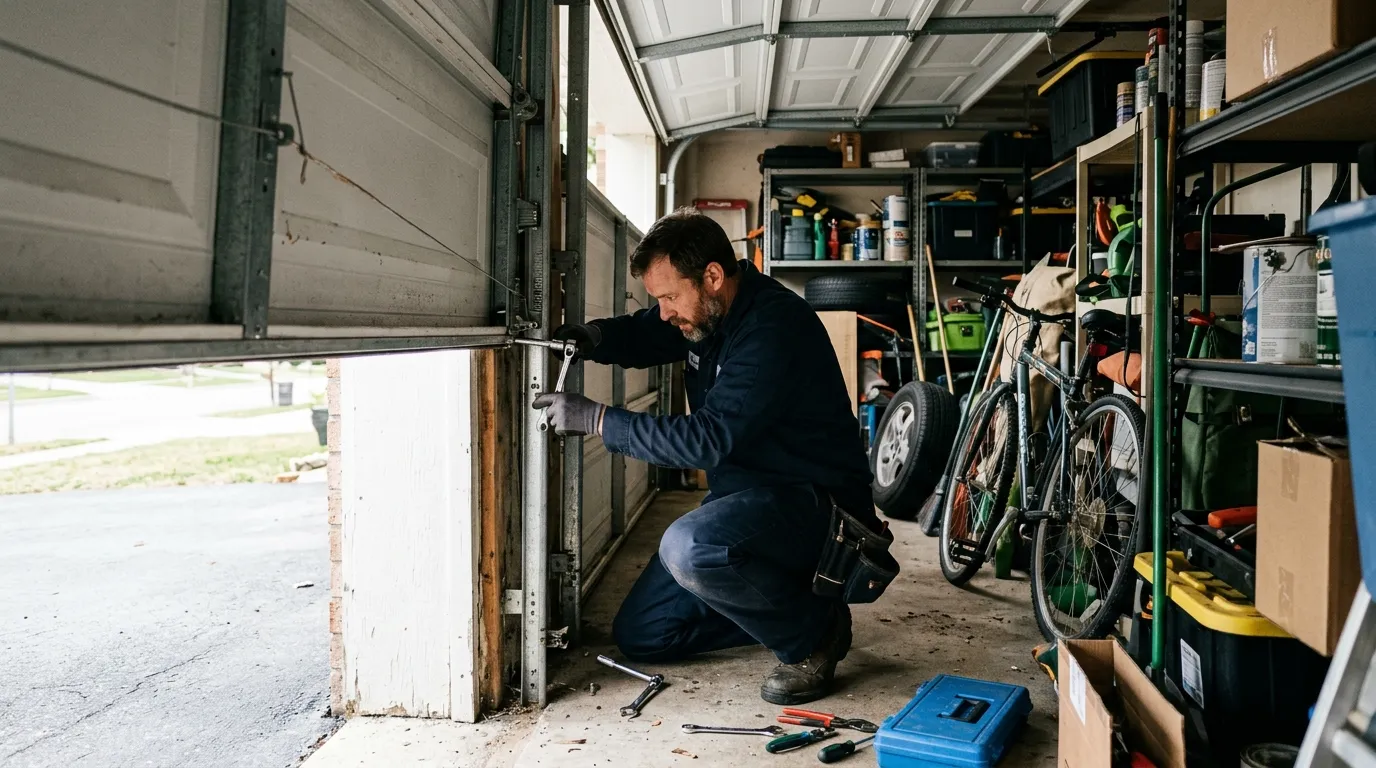
A snapped torsion spring looks like a clean gap in the coil above the door, usually with a loud bang at the moment it goes - homeowners often think something fell or a shelf collapsed in the garage. An extension spring failure is quieter but the door will feel unusually heavy or refuse to stay up partway. Other signs point to a spring on its way out rather than already gone: the door creeping down on its own after you open it, the opener motor straining and running hot, or a visible gap opening up between coils when the door is down. None of these are safe to force through with the opener alone - an opener isn't built to lift a door's full weight without spring assistance, and running it that way burns out the motor fast. If you can see daylight through a gap in the spring coil, or the door won't budge and you hear a metallic snap when you tried it, that's a spring, not a track or opener issue, and it's worth a call before anyone tries the emergency release cord.